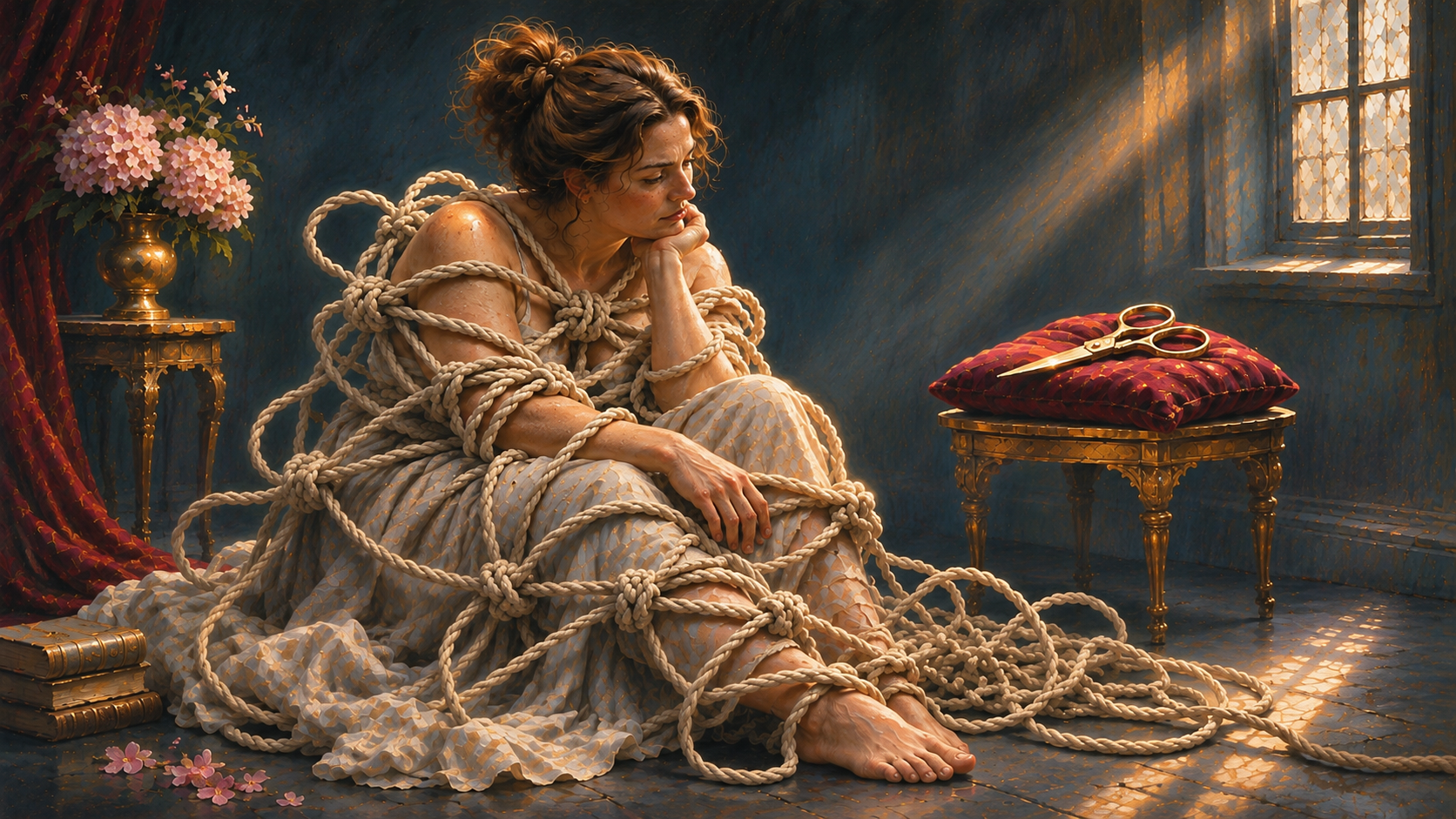
Then, on the horizon, a helping hand appears, holding a pair of scissors. It's called Ozempic, or more broadly, the GLP-1 injections. At last, someone can cut the cords and set you free. The easy way.
What an appeal. So many women are drawn to it, and why wouldn't they be? After years of struggling with food, weight and the exhausting business of trying again, the possibility of simply putting down that struggle is enormously tempting.
And these medications can make a real difference. Ozempic was developed for type 2 diabetes, while medicines such as Wegovy are also prescribed specifically for weight management. For many people, they offer something that has long seemed out of reach.
But there is something about the scissors that troubles me.
The easy way might be harder
Because scissors don't teach you how a knot was tied.
They can cut through what has become unbearable. They can offer relief. Sometimes, that relief may be exactly what someone needs.
But what happens afterwards?
For some people, weight returns when the injections stop. Others may decide to continue treatment for years. Neither possibility makes the medication a failure. It does, however, raise a question that deserves more attention than it often receives.
What have we learnt about ourselves along the way?
Have we discovered why certain evenings end in the kitchen, even when we aren't hungry? Why a difficult day seems to demand something sweet? Why do the resolutions we make on Sunday so often fall apart by Wednesday?
Or have we simply found a way to make those questions quieter?
There is a difference between being freed from a struggle and learning how to navigate it.
And perhaps the greatest difficulty with an easy solution is not that it fails to work. It is that we may come to depend on it without ever discovering what else could help us.
The slow hand
Untying a knot is not another diet.
A diet is often another attempt to pull harder at something we haven't understood.
Untying begins with looking.
Why do I reach for food at four in the afternoon? What happens on Friday nights? Which breakfast can I actually imagine eating for years, rather than for the next fourteen days?
These are ordinary questions. Almost disappointingly ordinary.
There is no dramatic transformation in choosing a breakfast that works. No great revelation in discovering that a certain evening routine makes life easier. No applause for making the same small, sensible decision again tomorrow.
At first, it can feel terribly slow.
But something curious happens when we repeat what works.
The unfamiliar becomes familiar. What once required constant attention begins to happen almost without thinking. The breakfast becomes your breakfast. Friday becomes an evening you know how to handle.
And what you know well becomes easier.
The harder way gets easier.
Of course, bodies are not simple puzzles, and weight is not determined by habits alone. Biology, health and circumstances all have their say. Medication can be an important part of someone's answer.
But understanding our own patterns has value regardless of whether we take medication.
It gives us something we can carry with us.
Free is not the same as untied
New knots will come. They always do.
Life changes. Our bodies change. What worked yesterday may no longer work tomorrow.
Perhaps freedom was never about reaching a point where nothing could tie us down again.
Perhaps it is about knowing that, when another knot appears, we have learnt something about how to approach it.
That is what matters to us at Waterlike. Not simply a lower number on the scale, but a way of eating that makes sense on an ordinary Tuesday. One that fits into a real life. One that we understand well enough to trust.
The greatest freedom is not always being untangled.
Sometimes, it is knowing how to untangle yourself.