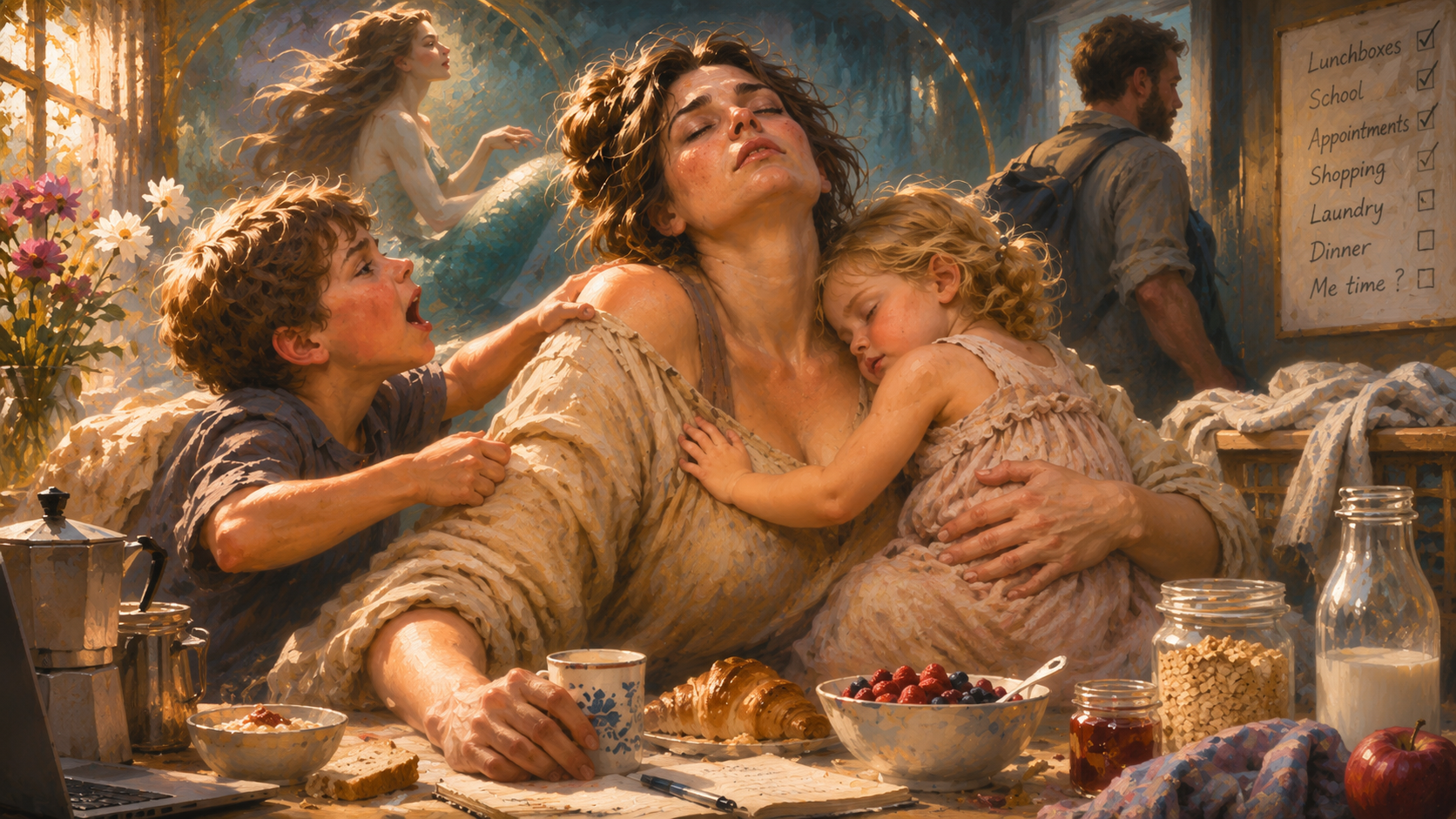
When life becomes a succession of obligations, relief is not a character flaw. It is a reflex. The question is not why she wanted the chocolate, but what else in her life was offering her anything at all.
Many women were taught early how to be good. Good meant agreeable, accommodating, quietly capable. It meant noticing what everyone needed before they had to ask. The good girl grows up extraordinarily skilled at saying yes to others, and strangely clumsy at saying it to herself. A boundary feels like unkindness. Anger feels like a malfunction. To admit she has reached her limit feels like admitting she does not love enough.
So when she cannot manage everything, she does not conclude that it was too much. She concludes that she is failing.
None of this is true of every mother. Some are held up by family, friends and neighbours, and find deep satisfaction in the work. Motherhood is not the problem. But there is a difference between being surrounded by people who need you and being surrounded by people who support you, and it is possible to live in the first while starving for the second. A house can be full and still be lonely.
Add the burden of noticing. Some mothers feel everything: a child's flicker of worry, a partner's tension, the mood of the room. It is a gift, and it is also labour that never clocks off. The realisation, when it arrives, is quiet. She is the emotional support system for everyone she loves, and she cannot name one person doing the same for her.
And people take. This is hard to say plainly, because it is rarely dramatic. Someone asks for one more thing, and she gives it. Someone is simply not there, absorbed by obligations elsewhere, and the gap is quietly filled by her. Someone is careless with her, a little dismissive, a little entitled to her patience. Each moment is small and deniable. Together they are a slow withdrawal from an account nobody pays into. She goes hungry in stages: emotionally first, then mentally, and at last, at the end of the day, physically.
She also allows it, and that is the uncomfortable part. The good girl's training does not switch off when others overstep. It makes her accommodate them. She absorbs the disrespect, makes allowances, calls it patience. Because everything is so subtle, there would be no way to explain an outburst. If she finally snapped, nobody would understand why. It is so easy to tread on her feet that no one notices they are doing it.
Then come the verdicts. Well, it's her own fault. Being a mum isn't that hard. She just needs to get organised. They are easy to dismiss from outside. They are harder to dismiss once they have moved in. The inner voice is stricter than any critic: be more disciplined, need less, complain less, never disappoint anyone.
This is where the armour comes in.
When a person is exposed, unsupported and steadily depleted, she looks for protection. In a better-resourced life it might be boundaries, friendship, an interest that belongs only to her. When those are missing, what remains is whatever is nearest: chocolate, crisps, the biscuit tin. And somewhere below conscious choice, the weight itself begins to feel like protection, something solid between her and everyone who takes. It is an image, not a medical claim, but anyone who has lived inside it will recognise it.
The world feels like a battlefield. Everyone is fighting for themselves, and nobody is fighting for her. Building a shield in such a place is not weakness. It is the only protection within reach.
And an armour is not something you put down while the world feels like a battlefield.
Yet she wants to be rid of it. Of course she does. She wants to be slim, to feel good in her body, to be beautiful, to be seen not as the person who keeps everything running but as a woman. Losing weight is the one project that seems to belong to her. But the shield is a weight too. Nobody walks around in armour in an ordinary world. It is ballast, and she knows it. She is carrying the very thing that was meant to protect her.
So she tries, and it does not work. Not because she lacks will, but because she is already running on empty. Emotionally and mentally she has been emptied for years, and now she is asked to give up something physical as well. We tell her it is simple: eat less, move more. As a principle, perhaps it is. But a simple principle is not an easy one to live by when you are starving in every other way. Food choices matter. Personal agency matters. But it is a great deal to ask of someone to lay down her only protection before anything else has been given back.
Loading Human: Mother tries to make the invisible visible. STRESS, LOAD and FUEL are not clinical measurements; they are the quiet arithmetic most women carry without ever being shown the numbers. Watch which one rises, and which one is left to run low.
The next time we see a woman struggling with her eating, perhaps the question is not why she cannot resist a piece of chocolate. Perhaps it is what her life is asking of her, what it has failed to give, and why she believes she must carry so much of it alone.